Skip to content
Route Optimization

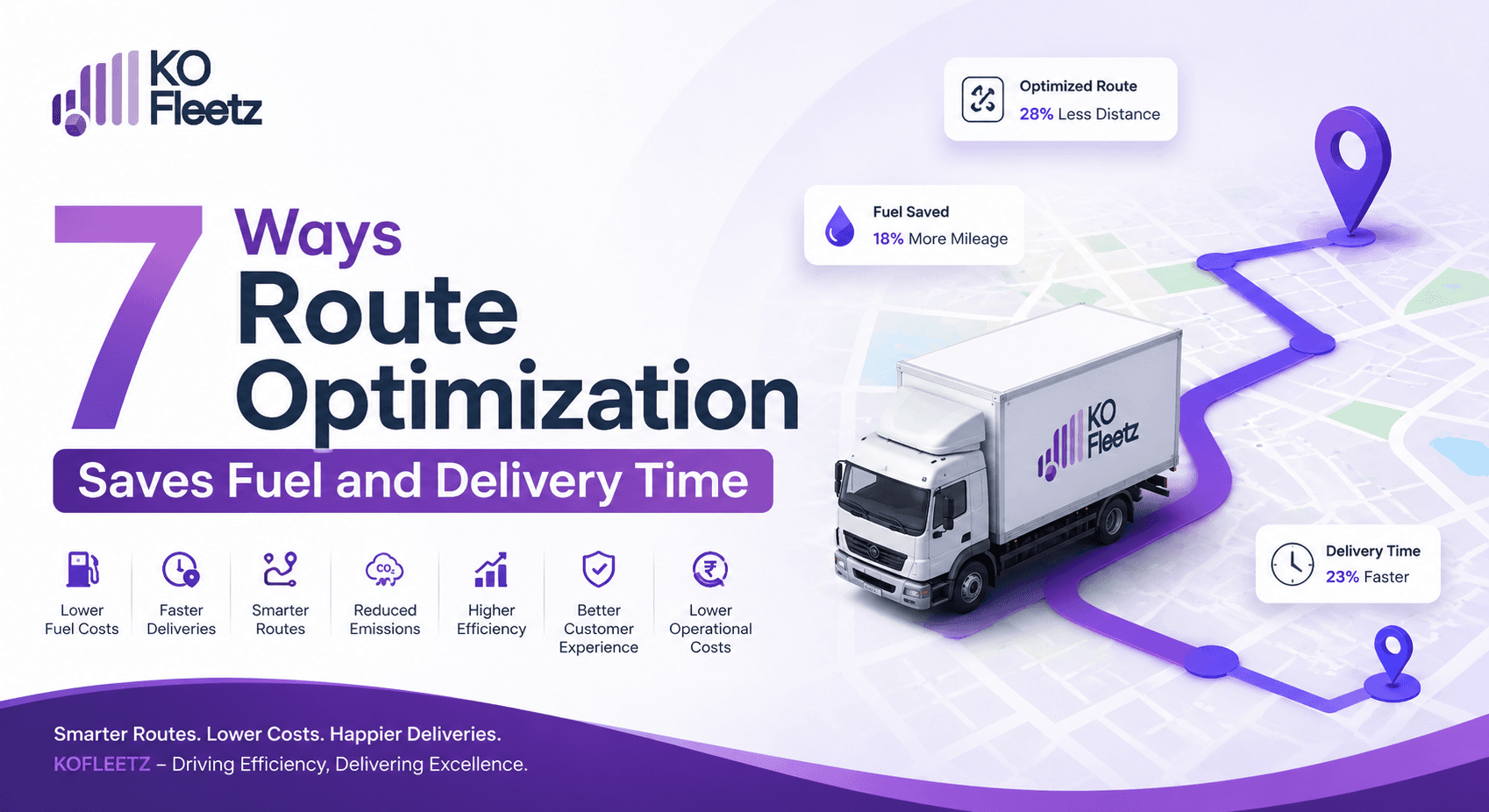
7 Ways Route Optimization Saves Fuel and Delivery Time

Route optimization helps logistics teams cut fuel use and complete deliveries faster. By improving route planning and fleet routing, companies reduce mileage, avoid delays, and boost overall efficiency with the right route planning software.

KO Fleetz Admin16 August 202616 min read
7 Ways Route Optimization Saves Fuel and Delivery Time
On this page

Introduction

For fleet-based businesses, fuel and delivery time are two of the biggest operating costs.

A vehicle taking a longer route, getting stuck in avoidable traffic, making unnecessary stops, or returning with an inefficient route may seem like a small operational issue. But when these inefficiencies happen across dozens or hundreds of vehicles every day, they can significantly increase fuel consumption, driver hours, vehicle wear, and delivery costs.

This is where route optimization becomes important.

Route optimization uses operational data, delivery locations, vehicle availability, traffic conditions, delivery priorities, and other constraints to determine more efficient routes for vehicles.

Instead of simply asking, "What is the shortest route from A to B?", modern route optimization asks a more useful question:

"What is the most efficient way to complete all required deliveries using the available vehicles and resources?"

For logistics companies, distributors, FMCG businesses, e-commerce operations, field-service teams, and other fleet-based organizations, effective route optimization can help reduce unnecessary kilometres, improve fuel efficiency, increase delivery productivity, and make daily fleet operations more predictable.

In this article, we explore 7 ways route optimization saves fuel and delivery time and why businesses are increasingly using route planning software to improve fleet performance.


What Is Route Optimization?

Route optimization is the process of finding the most efficient sequence of stops and routes for one or more vehicles while considering operational constraints.

Traditional route planning may depend heavily on driver experience or manually created routes. While this can work for smaller fleets, manual planning becomes increasingly difficult as the number of vehicles, customers, delivery locations, and operational constraints grows.

A route optimization system can consider factors such as:

  • Customer locations
  • Delivery time windows
  • Vehicle capacity
  • Vehicle availability
  • Traffic conditions
  • Road restrictions
  • Driver schedules
  • Priority deliveries
  • Number of stops
  • Distance between locations
  • Pickup and delivery requirements
  • Service duration at each location

The result is a more practical route that balances distance, time, vehicle utilization, and operational requirements.

This is different from simply selecting the shortest geographical path.

A shorter route is not always the fastest or most cost-effective route. A slightly longer road with less congestion may consume less fuel and allow a vehicle to complete more deliveries within the same working day.


7 Ways Route Optimization Saves Fuel and Delivery Time

1. Reduces Unnecessary Mileage

One of the most direct ways route optimization reduces costs is by minimizing unnecessary vehicle kilometres.

Without structured route planning, drivers may:

  • Travel through inefficient roads
  • Backtrack between delivery locations
  • Visit nearby customers at different times
  • Take unnecessarily long routes
  • Return to areas they have already covered

These additional kilometres translate directly into higher fuel consumption and longer driving hours.

Route optimization evaluates multiple delivery points and determines a logical sequence for completing them.

For example, imagine a delivery vehicle has 15 stops across a city.

A manually planned route might look like:

Warehouse → Customer A → Customer B → Customer C → Customer D → Customer E → Customer F

But if Customer E is geographically close to Customer A, a better sequence could reduce the distance travelled between stops.

When this optimization is performed across an entire fleet every day, even small reductions in kilometres can produce meaningful savings.

Why it matters

Lower mileage can mean:

  • Lower fuel consumption
  • Lower fuel expenditure
  • Less vehicle wear
  • Fewer driver hours
  • More deliveries per vehicle

This makes route optimization an important part of controlling fleet operating costs.


2. Improves Fuel Efficiency

Fuel efficiency is influenced by more than the vehicle itself.

Driving patterns, congestion, idling, acceleration, route length, road conditions, and unnecessary stops can all affect fuel consumption.

A well-designed route can reduce some of these inefficiencies by helping vehicles travel through more practical routes and avoid unnecessary driving.

For example, consider two possible routes:

Route A: 120 km with heavy traffic and frequent stops

Route B: 130 km with smoother traffic and fewer delays

At first glance, Route A appears better because it is shorter.

But if the vehicle spends significant time idling and repeatedly accelerating and braking, Route B could potentially be more operationally efficient.

This is why modern route planning should not focus only on distance.

It should consider the broader relationship between distance, travel time, traffic, stops, and vehicle utilization.

Better routing can contribute to improved fuel efficiency while helping fleets maintain predictable delivery schedules.


3. Helps Avoid Traffic and Delays

Traffic congestion can significantly affect delivery operations.

A vehicle may spend hours on the road without making meaningful progress toward completing deliveries.

Traffic also creates additional fuel consumption through:

  • Idling
  • Frequent acceleration
  • Frequent braking
  • Stop-and-go driving
  • Longer engine running time

Route optimization can incorporate traffic information and operational constraints to identify more efficient routes.

For example, if a major road experiences heavy congestion during certain hours, the system can help planners assign alternative routes or adjust delivery sequences.

This creates a more dynamic approach to route planning.

Instead of treating the road network as static, businesses can plan routes based on actual operating conditions.

The result

Better traffic-aware routing can help:

Reduce travel delays → Reduce idle time → Improve fuel efficiency → Complete deliveries faster

For businesses operating in busy urban areas, this can have a particularly significant impact.


4. Increases Deliveries Per Vehicle

Route optimization isn't only about reducing kilometres.

It is also about making better use of the kilometres a vehicle already travels.

A vehicle completing 10 deliveries in a day may not be performing as efficiently as a vehicle completing 15 deliveries over a similar operating period.

The difference often comes down to route structure.

By arranging stops more intelligently, fleet routing can help reduce the time spent travelling between customers and increase the number of productive stops completed during a shift.

For example:

Without optimized routing

  • 1 vehicle
  • 20 delivery locations
  • Long gaps between stops
  • Multiple route overlaps
  • Significant travel time

With optimized routing

  • 1 vehicle
  • Same 20 delivery locations
  • Better stop sequence
  • Reduced route overlap
  • More productive driving time

The goal is not simply to make drivers drive faster.

The goal is to remove unnecessary travel from their day.

That allows vehicles to spend more time completing deliveries rather than moving inefficiently between locations.


5. Reduces Empty or Partially Productive Trips

Empty kilometres are a major concern for many fleet operators.

A vehicle may complete a delivery and then travel a considerable distance before its next pickup or delivery.

This creates kilometres that generate limited or no revenue.

Route optimization can help businesses identify opportunities to combine pickups and deliveries more efficiently.

For example:

Inefficient route:

Warehouse → Delivery → Empty travel → Pickup → Empty travel → Delivery

More optimized route:

Warehouse → Delivery → Nearby Pickup → Delivery → Warehouse

The exact solution depends on the business model, vehicle capacity, delivery constraints, and customer requirements.

But the principle remains the same:

Make every kilometre more productive.

This is particularly important for logistics, distribution, FMCG, field service, and transportation businesses where vehicles may perform multiple trips throughout the day.


6. Improves Delivery Time and On-Time Performance

Fuel savings are only one side of route optimization.

The other major benefit is time efficiency.

Customers increasingly expect accurate and predictable delivery times.

Late deliveries can result in:

  • Customer dissatisfaction
  • Failed delivery attempts
  • Additional trips
  • Increased operating costs
  • SLA issues
  • Reduced customer retention

Route planning software can help create routes based on delivery priorities and time windows.

For example, if one customer requires delivery between 10:00 AM and 12:00 PM while another accepts deliveries throughout the afternoon, the route can be structured around those constraints.

This allows fleet managers to move beyond simple distance-based planning.

Instead, routes can be optimized around:

Who needs delivery → Where they are located → When they need it → Which vehicle should serve them

Better planning can improve on-time performance while reducing the need for emergency route changes.


7. Reduces Vehicle Operating Costs

Fuel is one of the most visible fleet expenses, but it is not the only one.

Every additional kilometre and unnecessary hour on the road can contribute to higher vehicle operating costs.

These may include:

  • Fuel
  • Tyre wear
  • Brake wear
  • Engine wear
  • Maintenance requirements
  • Driver overtime
  • Vehicle depreciation

When route optimization reduces unnecessary mileage and travel time, it can indirectly help control several of these costs.

For example:

Optimized routes

Fewer unnecessary kilometres

Less vehicle usage

Lower wear and maintenance pressure

Lower operating costs

This creates a broader business benefit beyond fuel savings.


Route Planning vs Route Optimization

Route planning and route optimization are closely related, but they are not exactly the same.

Route Planning

Route planning focuses on determining how a vehicle should travel from one location to another or how a set of stops should be arranged.

It may involve:

  • Selecting roads
  • Assigning stops
  • Creating delivery sequences
  • Planning driver schedules

Route Optimization

Route optimization goes a step further.

It evaluates multiple variables and constraints to identify a more efficient solution.

For example:

Route PlanningRoute Optimization
Creates a routeFinds an efficient route
May focus on distanceConsiders distance, time and constraints
Often manually managedCan be automated
Limited scalabilityDesigned for multiple vehicles
Basic stop sequencingDynamic stop and vehicle allocation
May use static informationCan incorporate changing conditions

For small operations, manual route planning may be sufficient.

For growing fleets with multiple vehicles and delivery points, automated route optimization can become significantly more valuable.


How Route Planning Software Helps Fleet Managers

Managing routes manually becomes increasingly difficult as fleet size grows.

A fleet manager may need to coordinate:

  • Dozens of vehicles
  • Hundreds of customers
  • Different vehicle capacities
  • Driver schedules
  • Delivery time windows
  • Traffic conditions
  • Priority orders
  • Pickup requirements

Trying to manage all these variables manually can take considerable time and still result in inefficient routes.

Route planning software can automate much of this process.

Instead of manually deciding which vehicle should visit which customer and in what sequence, the software can analyze available information and recommend optimized routes.

This can help fleet managers:

  • Reduce planning time
  • Improve vehicle utilization
  • Reduce unnecessary mileage
  • Manage more deliveries
  • Improve delivery visibility
  • Respond to operational changes
  • Track route performance

The biggest advantage is scalability.

A route plan that works for 5 vehicles may not work for 50 vehicles.

Software allows fleet operators to manage greater complexity without increasing manual planning effort at the same rate.


Route Optimization and Fleet Routing

Fleet routing becomes more complicated when multiple vehicles are involved.

Suppose a business has:

50 vehicles + 500 delivery locations

The question is no longer:

"What's the best route?"

Instead, fleet managers need to answer:

  • Which vehicle should handle each delivery?
  • Which vehicle has enough capacity?
  • Which driver is available?
  • Which route minimizes total travel?
  • Which customers have strict delivery windows?
  • How should urgent deliveries be prioritized?
  • Can multiple deliveries be combined?
  • Which vehicles are closest to specific locations?

This is where route optimization becomes particularly valuable.

A fleet routing system can help distribute deliveries across vehicles while considering operational constraints.

The objective is to improve overall fleet productivity rather than optimizing each vehicle independently.


Real-World Example: How Route Optimization Can Reduce Fleet Inefficiency

Consider a distribution company operating 20 delivery vehicles.

Each vehicle travels approximately 150 km per day.

That means:

20 × 150 km = 3,000 km per day

Now imagine route optimization reduces average travel by just 10%.

That represents:

3,000 × 10% = 300 km saved per day

Over 26 operating days:

300 × 26 = 7,800 km saved per month

This is only an illustrative example. Actual savings depend on the fleet, geography, vehicle type, traffic, delivery density, route structure, and optimization quality.

But the example demonstrates an important point:

Small route improvements can become significant when multiplied across an entire fleet.

The larger the fleet and the more frequently vehicles operate, the greater the potential impact of route optimization.


How to Measure Route Optimization Success

Implementing route optimization is only the first step.

Fleet managers should measure whether optimized routing is actually improving operations.

Important KPIs include:

1. Total Distance Travelled

Measure kilometres travelled before and after route optimization.

2. Fuel Consumption

Track fuel consumed per vehicle, trip, delivery, or kilometre.

3. Fuel Cost Per Delivery

Calculate how much fuel expenditure is associated with each completed delivery.

4. On-Time Delivery Rate

Measure the percentage of deliveries completed within the promised time window.

5. Deliveries Per Vehicle

Track the number of successful deliveries completed by each vehicle during a shift or day.

6. Average Route Duration

Compare the time required to complete routes before and after optimization.

7. Vehicle Utilization

Measure how effectively available vehicle capacity and operating hours are being used.

8. Empty Kilometres

Track kilometres travelled without productive pickup or delivery activity.

9. Driver Overtime

Monitor whether better route planning reduces excessive driving hours and overtime.

10. Cost Per Delivery

Ultimately, businesses should measure whether route optimization is reducing the total cost of fulfilling deliveries.


Common Route Optimization Mistakes

Even businesses using route planning software can make mistakes if the underlying process is not properly configured.

Optimizing Only for Distance

The shortest route isn't always the best route.

Traffic, delivery windows, road restrictions, vehicle capacity, and service time also matter.

Ignoring Delivery Time Windows

A route may be geographically efficient but operationally impossible if customers require specific delivery times.

Using Inaccurate Customer Data

Incorrect addresses or outdated customer information can result in poor route recommendations.

Ignoring Vehicle Capacity

A route can be geographically perfect but impossible if the assigned vehicle cannot carry the required load.

Treating Routes as Static

Real-world conditions change.

Traffic, cancellations, urgent orders, vehicle breakdowns, and new deliveries can require route adjustments.

Failing to Measure Results

Without comparing KPIs before and after optimization, businesses may not know whether their routing strategy is delivering measurable value.


The Role of Technology in Modern Route Optimization

Modern fleet operations are moving away from isolated spreadsheets and manual route planning.

Connected fleet management platforms can bring together:

  • GPS tracking
  • Vehicle data
  • Delivery information
  • Driver information
  • Fuel data
  • Route planning
  • Fleet analytics
  • Operational alerts

This creates a more connected approach to fleet management.

Instead of simply knowing where vehicles are, fleet managers can understand how efficiently those vehicles are being used.

The combination of GPS tracking + route optimization + fleet analytics can help businesses move from reactive fleet management toward proactive operational decision-making.


Route Optimization and Fuel Management

Route optimization should also be considered alongside fuel management.

Fuel costs can increase because of:

  • Excessive mileage
  • Idling
  • Congestion
  • Poor driving patterns
  • Unnecessary trips
  • Inefficient route sequences

Route optimization primarily addresses the route and travel efficiency side of the equation.

Fuel management can provide visibility into actual fuel consumption.

Together, these capabilities can help fleet managers answer questions such as:

Which routes consume the most fuel?

Which vehicles have unusually high fuel consumption?

Are longer routes actually producing more deliveries?

Where are unnecessary kilometres occurring?

How much fuel could potentially be saved through better route planning?

This makes route optimization more valuable when it is connected to broader fleet analytics.


Why Route Optimization Matters for Growing Fleets

As a fleet grows, operational complexity increases.

Managing 5 vehicles manually may be straightforward.

Managing 50, 100, or 500 vehicles introduces significantly more variables.

More vehicles mean:

  • More drivers
  • More delivery locations
  • More route combinations
  • More fuel consumption
  • More operational decisions
  • More opportunities for inefficiency

Manual planning does not necessarily scale at the same rate as the fleet.

Route optimization software helps address this challenge by automating complex routing decisions and providing fleet managers with a structured way to plan and adjust operations.

For growing logistics businesses, this can become an important part of building a scalable delivery operation.


Frequently Asked Questions

What is route optimization?

Route optimization is the process of finding efficient routes for vehicles while considering factors such as distance, travel time, delivery locations, vehicle capacity, traffic, driver schedules, and delivery time windows.

How does route optimization save fuel?

Route optimization can reduce unnecessary kilometres, backtracking, traffic exposure, idle time, and inefficient trips. Reducing these factors can help lower fuel consumption.

Does route optimization reduce delivery time?

Yes. By improving stop sequences, reducing unnecessary travel, and considering traffic and delivery constraints, route optimization can help vehicles complete routes more efficiently.

What is route planning software?

Route planning software is a digital solution that helps businesses create, manage, and optimize vehicle routes. Advanced platforms can consider multiple vehicles, delivery locations, time windows, capacity, traffic, and operational constraints.

Is route optimization useful for small fleets?

Yes. While the benefits can become more significant as fleet complexity increases, even smaller fleets can use route optimization to reduce unnecessary kilometres and improve delivery planning.

What is the difference between route planning and route optimization?

Route planning involves creating a route or sequence of stops. Route optimization evaluates multiple possible routes and operational constraints to identify a more efficient solution.

Can route optimization improve fuel efficiency?

It can contribute to better fuel efficiency by reducing unnecessary distance, avoiding inefficient travel patterns, reducing idle-heavy routes, and improving overall fleet utilization.

Can route optimization handle multiple vehicles?

Yes. Fleet-level route optimization can assign deliveries across multiple vehicles while considering vehicle capacity, availability, delivery windows, and other operational constraints.


Conclusion

Fuel and delivery time are closely connected to how efficiently a fleet operates.

Every unnecessary kilometre, avoidable delay, inefficient stop sequence, and empty trip can increase operating costs.

Route optimization provides a systematic way to address these inefficiencies.

By reducing unnecessary mileage, improving fuel efficiency, avoiding delays, increasing deliveries per vehicle, reducing unproductive trips, improving delivery times, and controlling vehicle operating costs, optimized routing can have a measurable impact on fleet performance.

For modern logistics and transportation businesses, route planning is no longer simply about finding a road from one location to another.

It is about making every vehicle, kilometre, driver hour, and delivery count.

With the right route planning software, fleet managers can move from manual route planning to data-driven fleet routing and delivery optimization.

Better routes don't just save kilometres. They help businesses save time, fuel, and money.

Share
  • Fleet Management Software

    Best Fleet Management Software in India: Complete Buyer’s Guide

    Choosing the right fleet management software in India can improve visibility, control operating costs, and streamline daily fleet operations. This buyer’s guide explains the key features and factors to consider before choosing a solution.

    12 Aug 20265 min
  • Fleet Management Software

    Top 10 Benefits of Fleet Management Software for Logistics Companies

    Fleet management software helps logistics companies track vehicles in real time, reduce fuel and maintenance costs, improve driver safety, optimize routes, and increase delivery efficiency. Here are the top 10 benefits that make it essential for modern logistics operations.

    12 Aug 20263 min
  • Fleet Management Software

    What Is Fleet Management Software and How Does It Work?

    Fleet management software is a centralized platform that monitors vehicles, drivers, fuel, maintenance, routes and safety. It turns GPS & telematics data into real-time insights, alerts and analytics — helping fleets reduce costs, improve utilization and make smarter decisions.

    11 Aug 20264 min

See KO Fleetz running on your fleet

A 30-minute walkthrough using your vehicles, your routes and the problems you are actually trying to solve.