Skip to content
Fleet Management Software

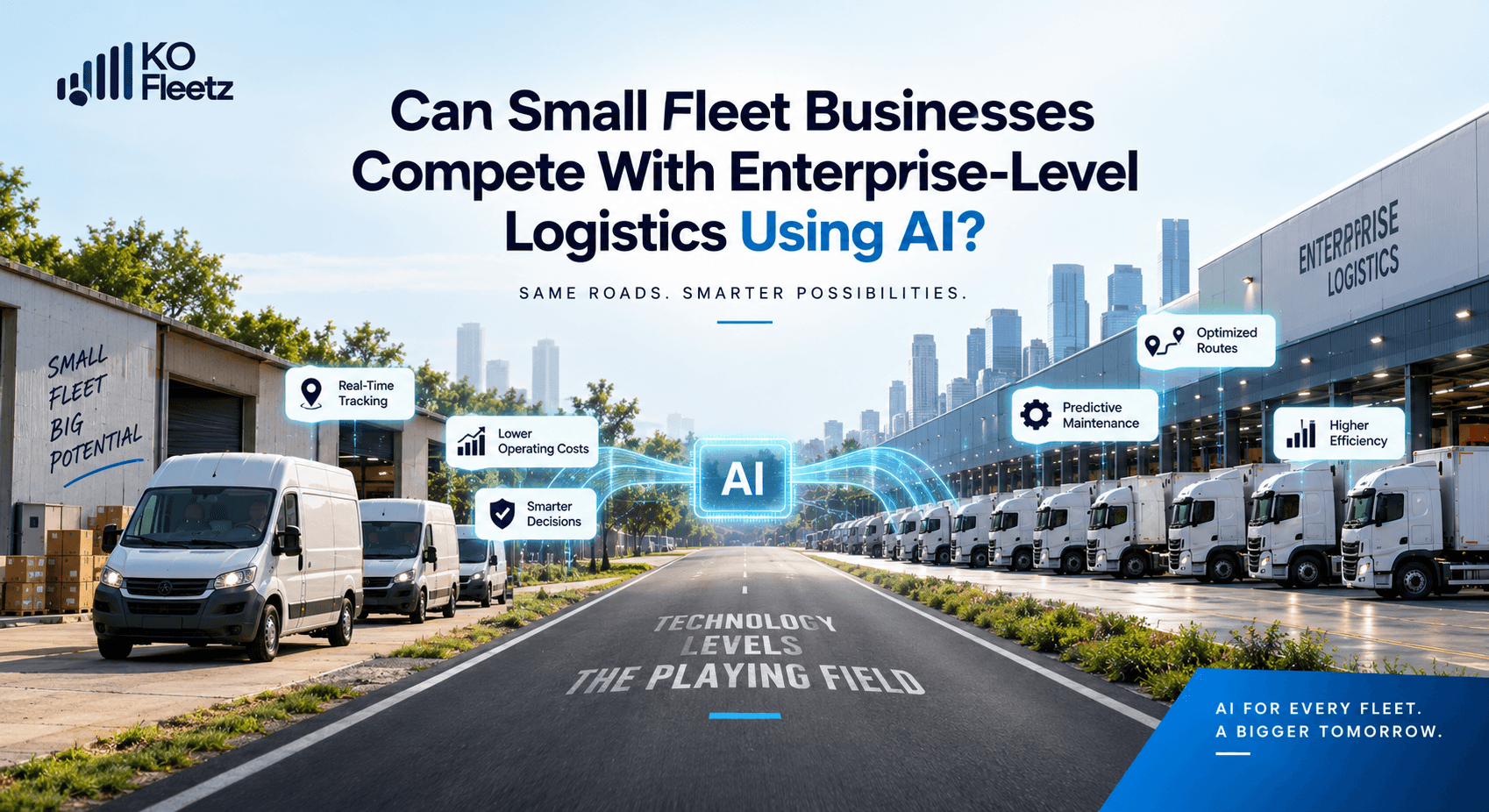
Can Small Fleet Businesses Compete With Enterprise-Level Logistics Using AI?

AI fleet management software helps small fleet businesses automate operations, optimize routes, control costs, improve visibility, and compete more effectively with larger logistics companies.

KO Fleetz Admin8 September 20265 min read
Can Small Fleet Businesses Compete With Enterprise-Level Logistics Using AI?
On this page

Introduction

Large logistics companies have traditionally had an advantage: bigger fleets, larger technology budgets, dedicated operations teams, and access to extensive data.

Today, technology is changing that equation.

AI fleet management software allows small fleet businesses to automate routine tasks, analyze operational data, optimize transportation, and make faster decisions without building an enterprise-level technology infrastructure.

The question is no longer whether a small fleet can match the size of a large logistics company. It is whether it can operate smarter and more efficiently.

What Makes Enterprise Logistics Different?

Enterprise logistics companies typically have sophisticated systems for:

  • Route planning
  • Fleet tracking
  • Driver management
  • Fuel monitoring
  • Maintenance
  • Dispatch
  • Analytics
  • Transportation planning

Historically, these capabilities could require expensive software and significant IT resources.

AI and cloud-based fleet management software for small businessesCan Small Fleet Businesses Compete With Enterprise-Level Logistics Using AI? are making many of these capabilities more accessible to smaller operators.

5 Ways AI Helps Small Fleets Compete

1. Smarter Route Optimization

Route planning can become complicated when vehicles handle multiple deliveries or changing schedules.

AI-powered systems can analyze operational data and help identify more efficient routes based on available information.

Better routing can help reduce unnecessary mileage, travel time, and fuel consumption.

2. Automated Fleet Operations

Small fleet teams often manage several responsibilities at once.

Fleet automation can reduce repetitive work such as:

  • Trip planning
  • Vehicle assignment
  • Maintenance reminders
  • Fuel monitoring
  • Reporting
  • Operational updates

This allows a small team to manage more vehicles and trips without increasing administrative workload at the same rate.

3. Better Cost Control

Large logistics companies can absorb inefficiencies more easily because of their scale. For smaller businesses, every unnecessary kilometer and unexpected repair can directly affect profitability.

AI-powered fleet management software can bring fuel, maintenance, trip, and vehicle data together.

Managers can use this information to identify cost trends and areas where operational efficiency can improve.

4. Predictive Fleet Management

Traditional fleet management is often reactive.

A vehicle breaks down, a route is delayed, or fuel consumption increases—and the team responds afterward.

AI can help move fleet operations toward a more proactive model by identifying patterns in historical and operational data.

This can support earlier attention to potential maintenance issues, unusual fuel consumption, or operational inefficiencies.

5. Enterprise-Level Visibility

A small fleet does not need hundreds of vehicles to benefit from data-driven management.

A modern AI fleet management system can provide dashboards and reports covering:

  • Vehicle performance
  • Fleet utilization
  • Fuel efficiency
  • Maintenance costs
  • Trip performance
  • Route efficiency
  • Driver performance
  • Operating expenses

This gives smaller businesses the visibility needed to make decisions with greater confidence.

AI Does Not Replace Good Fleet Management

AI is a tool—not a replacement for experienced fleet managers.

The best results come when AI-supported insights are combined with operational knowledge.

Managers still need to consider factors such as customer requirements, vehicle capabilities, driver availability, road conditions, delivery priorities, and business constraints.

AI helps process information faster so teams can spend more time acting on it.

What Should Small Fleet Businesses Automate First?

Small operators do not need to automate everything immediately.

A practical starting point is:

1. Fleet Tracking Know where vehicles are and monitor trip progress.

2. Route Optimization Reduce unnecessary travel and improve delivery planning.

3. Fuel Management Track consumption and identify unusual costs.

4. Maintenance Management Move from reactive repairs toward preventive maintenance.

5. Fleet Analytics Understand vehicle utilization, costs, and operational performance.

Once these foundations are established, businesses can gradually introduce more advanced automation and AI capabilities.

How to Choose AI Fleet Management Software

Small businesses should focus on practical value rather than choosing a platform simply because it uses AI.

Look for software that offers:

  • Easy implementation
  • Clear dashboards
  • Fleet tracking
  • Trip management
  • Route optimization
  • Fuel management
  • Maintenance management
  • Automated alerts
  • Analytics and reporting
  • Integration capabilities
  • Scalability

Most importantly, the system should solve real operational problems without creating unnecessary complexity.

Can Small Fleets Really Compete?

Yes—but the advantage is not necessarily having the same resources as an enterprise.

A small fleet can compete by being:

  • Faster to make decisions
  • More responsive to customers
  • More efficient with vehicles
  • More disciplined with costs
  • More automated
  • More data-driven

AI fleet management software for small businesses can help close the technology gap by giving smaller operators access to capabilities that were once primarily associated with large logistics organizations.

The Future of Small Fleet Operations

As AI becomes more integrated into logistics software, fleet management will increasingly move from manual monitoring toward intelligent automation.

Small fleet businesses that adopt digital tools early can build operational advantages without needing enterprise-scale infrastructure.

The goal is simple: do more with the fleet you already have.

Conclusion

Enterprise logistics companies may have scale, but small fleets can compete through agility, efficiency, and technology.

With the right AI fleet management software, small fleet businesses can automate repetitive operations, optimize routes, control costs, improve fleet visibility, and make better operational decisions.

AI does not make fleet size irrelevant. It makes operational efficiency more accessible.

For small and growing fleet businesses, adopting AI-powered fleet management can be a practical step toward competing in an increasingly technology-driven logistics market.

Make Your Fleet Smarter

KO Fleetz helps businesses connect fleet operations across vehicles, trips, drivers, fuel, maintenance, expenses, and analytics through a centralized fleet management platform.

Explore KO Fleetz and discover how smarter fleet management can help your business operate more efficiently.

Share
  • Fleet Management Software

    Common Fleet Management Challenges and Solutions

    Fleet managers face challenges involving fuel costs, vehicle maintenance, driver performance, route efficiency, compliance, and operational visibility. Discover practical solutions for improving fleet operations.

    27 Aug 20265 min
  • Fleet Management Software

    7 Differences Between Digital and Manual Fleet Management

    Digital fleet management uses software and real-time data to run fleets more efficiently than manual methods. Learn the 7 major differences between digital and manual approaches and how fleet management software improves visibility, cost control and performance.

    24 Aug 20264 min

See KO Fleetz running on your fleet

A 30-minute walkthrough using your vehicles, your routes and the problems you are actually trying to solve.