Skip to content
Fleet Operating Cost

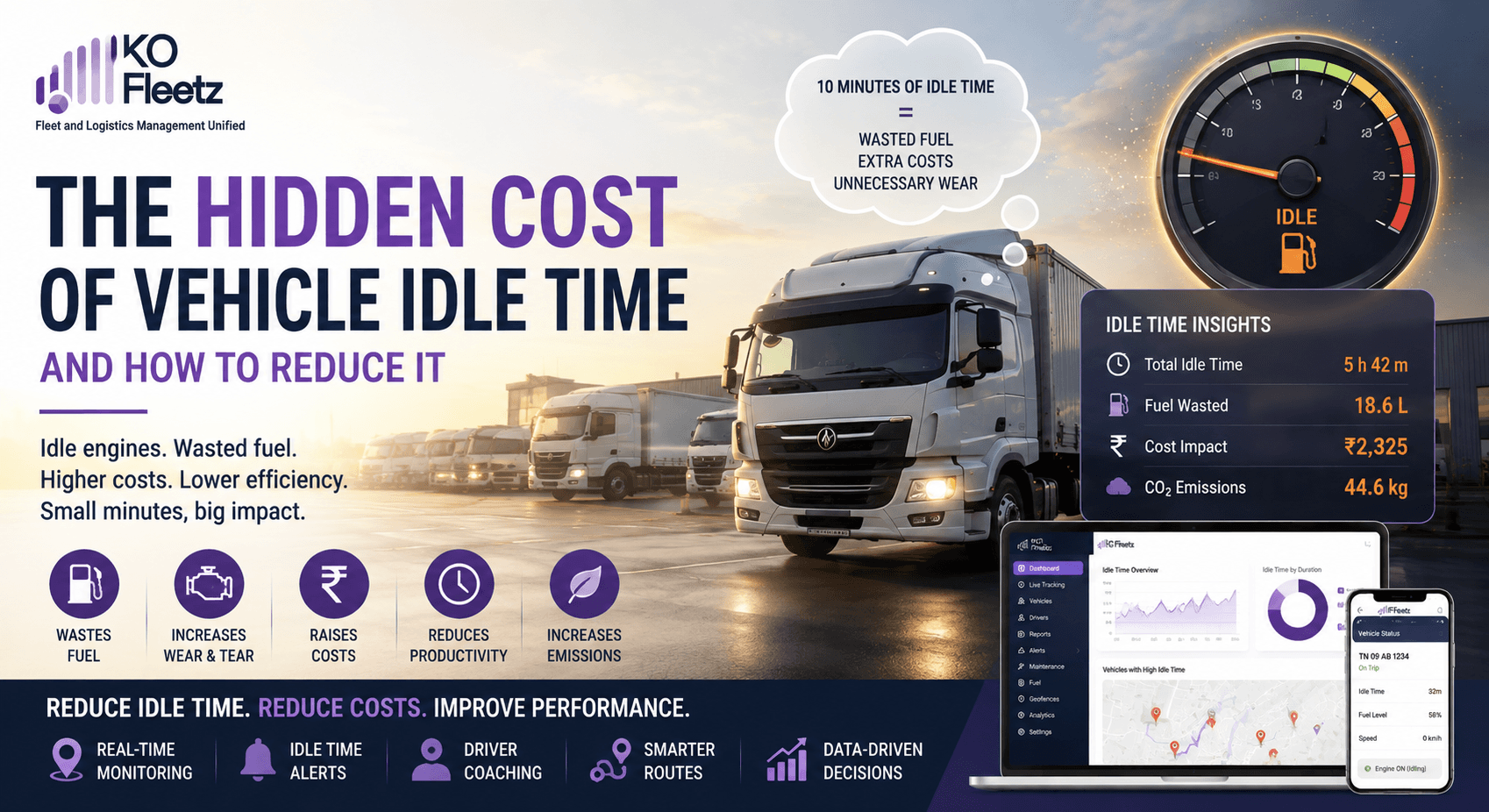
The Hidden Cost of Vehicle Idle Time and How to Reduce It

Vehicle idle time may seem harmless, but those minutes add up to wasted fuel, higher costs, and unnecessary vehicle wear. Learn how fleet management software can help reduce idling and improve fleet efficiency.

KO Fleetz Admin14 August 20265 min read
The Hidden Cost of Vehicle Idle Time and How to Reduce It
On this page

The Hidden Cost of Vehicle Idle Time and How to Reduce It

A vehicle sitting still with its engine running may not look like a major problem.

But across a fleet, those minutes can quickly turn into hours of wasted fuel, unnecessary engine wear, and higher operating costs.

For logistics and transport companies, reducing idle time is one of the simplest ways to improve fleet efficiency without adding more vehicles.

With the right fleet management software, managers can identify where idling happens, understand why it happens, and take action.

What Is Vehicle Idle Time?

Vehicle idle time occurs when the engine is running while the vehicle is stationary.

Some idling is unavoidable. Drivers may need to wait at loading points, traffic signals, customer locations, warehouses, or during specific operational activities.

The problem starts when unnecessary idling becomes a regular habit.

Common examples include:

  • Waiting with the engine running
  • Long loading or unloading stops
  • Traffic-related delays
  • Driver rest periods with the engine running
  • Waiting for dispatch instructions
  • Unplanned stops

Individually, these may seem small. Across hundreds of trips, they can become a significant cost.

Why Excessive Idling Costs More Than You Think

1. It Wastes Fuel

An idling engine continues consuming fuel even though the vehicle is not moving.

When multiplied across multiple vehicles and working days, unnecessary idling can have a noticeable impact on the monthly fuel bill.

2. It Increases Vehicle Wear

Long periods of idling put unnecessary operating hours on the engine and other components.

This can contribute to additional maintenance requirements over time.

3. It Reduces Fleet Productivity

A vehicle that spends too much time idling is not being used productively.

Reducing idle time can help vehicles spend more time completing useful trips and deliveries.

4. It Increases Operating Costs

Fuel, maintenance, vehicle wear, and lost productive time all contribute to the total cost of operating a fleet.

That makes idle time more than a fuel problem. It is an overall fleet efficiency problem.

7 Ways to Reduce Vehicle Idle Time :

1. Track Idle Time

You cannot reduce a problem you cannot see.

Use GPS fleet tracking and fleet management software to monitor how long vehicles remain stationary with the engine running.

Identify vehicles, routes, drivers, and locations with unusually high idle time.

2. Set Idle Time Alerts

Automated alerts can notify managers when a vehicle exceeds a defined idle period.

Instead of checking every vehicle manually, teams can focus on exceptions that need attention.

3. Identify the Reasons Behind Idling

Not every idle event is unnecessary.

Look for patterns around warehouses, customer locations, traffic-heavy routes, loading areas, and driver waiting times.

Understanding the reason behind the idle event makes it easier to fix the actual problem.

4. Improve Route Planning

Poor routes can create unnecessary waiting and congestion.

Better route planning can help drivers avoid inefficient journeys, reduce delays, and spend less time sitting in traffic.

5. Coach Drivers Using Real Data

Driver behaviour can have a direct impact on fuel efficiency.

Use idle-time reports to identify recurring patterns and discuss them with drivers. Data-based coaching is more useful than simply telling drivers to reduce idling.

6. Improve Dispatch and Scheduling

Drivers may idle because they arrive too early or have to wait for instructions, loading, unloading, or customer availability.

Better scheduling and communication between dispatch teams and drivers can reduce unnecessary waiting.

7. Monitor Improvements Over Time

Reducing idle time is not a one-time exercise.

Track idle performance regularly and compare vehicles, drivers, routes, and time periods. This helps fleet teams understand whether their changes are actually working.

How Fleet Management Software Helps

Modern fleet management software can turn idle-time data into useful operational insights.

With the right platform, managers can:

  • Monitor vehicle locations in real time
  • Track idle duration
  • Receive excessive-idling alerts
  • Compare driver performance
  • Analyze routes and stops
  • Monitor fuel efficiency
  • Identify operational bottlenecks
  • Measure improvements over time

This moves fleet management from simply tracking vehicles to actively improving how they are used.

How Kofleetz Helps Reduce Idle Time

Kofleetz helps fleet teams understand where time and fuel are being lost.

With real-time fleet visibility, idle monitoring, route insights, driver behaviour data, and analytics, managers can identify inefficient patterns and take action.

Kofleetz helps businesses:

  • Find vehicles with excessive idle time
  • Monitor fuel-related inefficiencies
  • Improve route planning
  • Understand driver behaviour
  • Improve vehicle utilization
  • Reduce unnecessary operating costs

The goal is not simply to reduce a number on a dashboard. It is to make every vehicle spend more time doing productive work.

Measure the Impact on Fleet Costs

Idle time should be viewed as part of the bigger fleet cost picture.

When you combine idle-time data with fuel consumption, mileage, vehicle utilization, and maintenance information, you get a clearer understanding of where money is being spent.

A fleet cost calculator can also help businesses estimate their operating costs and identify potential areas for savings.

You can explore fleet management solutions and tools at www.kofleetz.com.

Final Thoughts

Idle time is easy to overlook because it happens in small increments.

Five minutes here. Ten minutes there. An unnecessary wait at one location and a long engine-on stop at another.

Across an entire fleet, those minutes add up.

Reducing vehicle idle time can help lower fuel waste, improve vehicle utilization, reduce unnecessary wear, and control operating costs.

With fleet management software, businesses can see where idling happens and take practical steps to reduce it.

Kofleetz gives fleet teams the visibility and insights they need to turn idle time into better fleet efficiency.

Share
  • FMCG & Distribution

    Fleet Management Software for FMCG Distribution

    Fleet management software for FMCG helps distributors optimize delivery routes, reduce fuel costs, improve vehicle utilization, track deliveries, and streamline daily distribution operations.

    31 Aug 20262 min
  • Manufacturing

    Fleet Management Software for Manufacturing Companies

    Discover how fleet management software helps manufacturing companies reduce transportation costs, improve vehicle utilization, minimize downtime, optimize fleet operations, and gain better visibility across their transportation network.

    28 Aug 20266 min

See KO Fleetz running on your fleet

A 30-minute walkthrough using your vehicles, your routes and the problems you are actually trying to solve.