Skip to content
Transportation Management

Bilty: What It Is & What Every Field Means

A bilty is a key transport document used to record goods movement. Learn what bilty means, why it matters, and what each field on a bilty document represents.

KO Fleetz Admin16 September 20265 min read
Bilty: What It Is & What Every Field Means
On this page

What Is a Bilty?

A bilty is a transport document used in India to record the movement of goods from one location to another.

It is commonly issued by a transporter or transport operator when goods are accepted for transportation. A bilty contains important information about the consignor, consignee, goods, vehicle, freight, and delivery.

Bilty is also commonly referred to as an LR (Lorry Receipt) or goods transport receipt, depending on the transport operation and terminology used.

Why Is a Bilty Important?

A bilty creates a documented record of a transportation transaction.

It can help businesses and transporters:

  • Identify the consignor and consignee
  • Record details of the goods
  • Identify the vehicle carrying the shipment
  • Track freight and payment information
  • Maintain transportation records
  • Support delivery verification
  • Improve documentation and accountability

For businesses handling a large number of trips, creating and managing these documents manually can become difficult. Digital transportation management systems can help streamline the process.

What Does a Bilty Contain?

A bilty can vary by transporter and business, but common fields include the following.

1. Bilty Number

The bilty number is the unique reference number assigned to the transport document.

It helps identify and retrieve the specific shipment or consignment record.

2. Date

This is the date on which the bilty is generated or the goods are accepted for transportation.

3. Consignor Details

The consignor is the person or business sending the goods.

This section may include:

  • Name
  • Address
  • Contact details
  • GST information, where applicable

4. Consignee Details

The consignee is the person or business receiving the goods.

The bilty may contain the consignee's name, address, contact information, and applicable tax details.

5. Pickup Location

This identifies where the goods are collected.

6. Delivery Location

This specifies the destination where the goods are expected to be delivered.

7. Vehicle Number

The registration number of the vehicle transporting the goods is recorded here.

This connects the shipment with the physical vehicle.

8. Driver Details

Depending on the format, the bilty may include the driver's name, contact information, or other identification details.

9. Goods Description

This field describes what is being transported.

It may include:

  • Product description
  • Number of packages
  • Type of packaging
  • Weight
  • Quantity

10. Freight Amount

The freight field records the transportation charge agreed for moving the goods.

The exact calculation can depend on distance, weight, quantity, route, contract, or other commercial terms.

11. Payment Terms

This indicates how the freight will be paid.

Common arrangements may include:

  • To Pay
  • Paid
  • To Be Billed

The terminology can vary between transporters.

12. GST and Tax Details

Where applicable, tax-related information may be recorded on the transport document.

Businesses should ensure that their documentation follows the applicable tax and transportation requirements.

13. E-Way Bill Number

For consignments where an e-Way Bill is required, the relevant e-Way Bill information may be associated with the transport documentation.

14. Special Instructions

Additional instructions can include handling requirements, delivery instructions, or other shipment-specific information.

15. Signature or Acknowledgement

The bilty may include signatures or acknowledgements from relevant parties as evidence of acceptance or receipt.

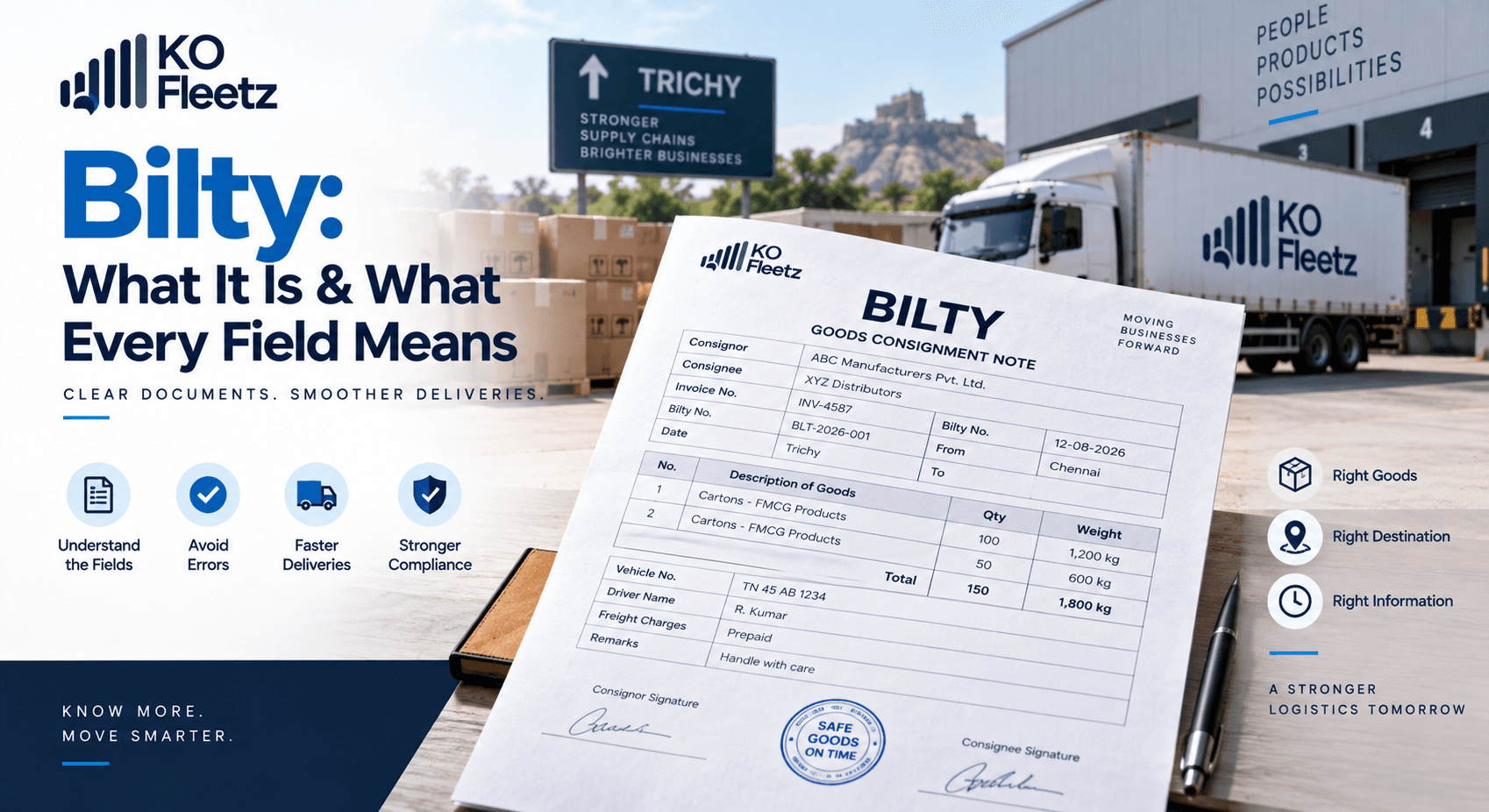
Bilty Example

A simplified bilty may contain:

FieldExample
Bilty No.BLT-10245
Date16-09-2026
ConsignorABC Manufacturing
ConsigneeXYZ Distributors
PickupChennai
DeliveryCoimbatore
Vehicle No.TN XX XX 1234
GoodsFMCG Products
Packages120
Weight2,500 kg
Freight₹18,000
PaymentTo Pay
E-Way BillApplicable reference

This is a simplified example. Actual bilty formats vary between transport companies.

Bilty vs Lorry Receipt

The terms bilty and lorry receipt (LR) are often used interchangeably in Indian road transportation.

However, terminology and document formats can differ between transporters and regions.

The important point is that the document records key information about the consignment and its transportation.

Can Bilty Management Be Digitized?

Yes. Transport businesses managing high shipment volumes can digitize bilty creation and management.

A transportation management or fleet management platform can connect shipment documentation with:

  • Trips
  • Vehicles
  • Drivers
  • Consignments
  • Freight
  • Delivery status
  • E-Way Bill information
  • Operational records

This reduces dependence on paper documents and disconnected spreadsheets.

How KO Fleetz Can Help

KO Fleetz provides connected transportation and fleet operations capabilities that can help businesses manage trips, vehicles, drivers, freight, documents, and related operational information from a centralized platform.

For transport operators handling frequent consignments, connecting documentation with actual fleet operations can improve visibility and reduce manual coordination.

Frequently Asked Questions

What is a bilty in transportation?

A bilty is a transport document used to record important information about goods being transported, including the consignor, consignee, vehicle, goods, destination, and freight details.

Is bilty the same as an LR?

In Indian road transportation, bilty and Lorry Receipt (LR) are commonly used to refer to the transport receipt issued for a consignment, although terminology and formats can vary.

Who issues a bilty?

Typically, the transporter or transport operator issues the bilty when goods are accepted for transportation.

Is bilty mandatory for every shipment?

Documentation requirements depend on the type of shipment, applicable laws, and transportation arrangements. Businesses should follow the current requirements applicable to their particular consignment.

Conclusion

A bilty is more than a simple transport receipt. It records critical information connecting the goods, sender, receiver, vehicle, driver, freight, and delivery.

Understanding each field makes it easier for businesses to verify shipments, maintain accurate records, and manage transportation operations.

As logistics operations become increasingly digital, connecting bilty and shipment information with fleet and transportation management systems can further improve operational visibility and efficiency.

Share
  • Construction Fleet Management

    Construction Fleet Management Software

    Construction fleet management software helps construction companies track vehicles, control fuel and maintenance costs, improve equipment utilization, and manage fleet operations from one platform.

    15 Sept 20263 min
  • Fleet Management Software

    Top Fleet Management Software in India

    Compare leading fleet management options in India and see how KO Fleetz combines fleet operations, tracking, fuel, maintenance, dispatch, analytics, AI, and Indian compliance in one platform.

    11 Sept 20265 min

See KO Fleetz running on your fleet

A 30-minute walkthrough using your vehicles, your routes and the problems you are actually trying to solve.