Skip to content
Freight Management

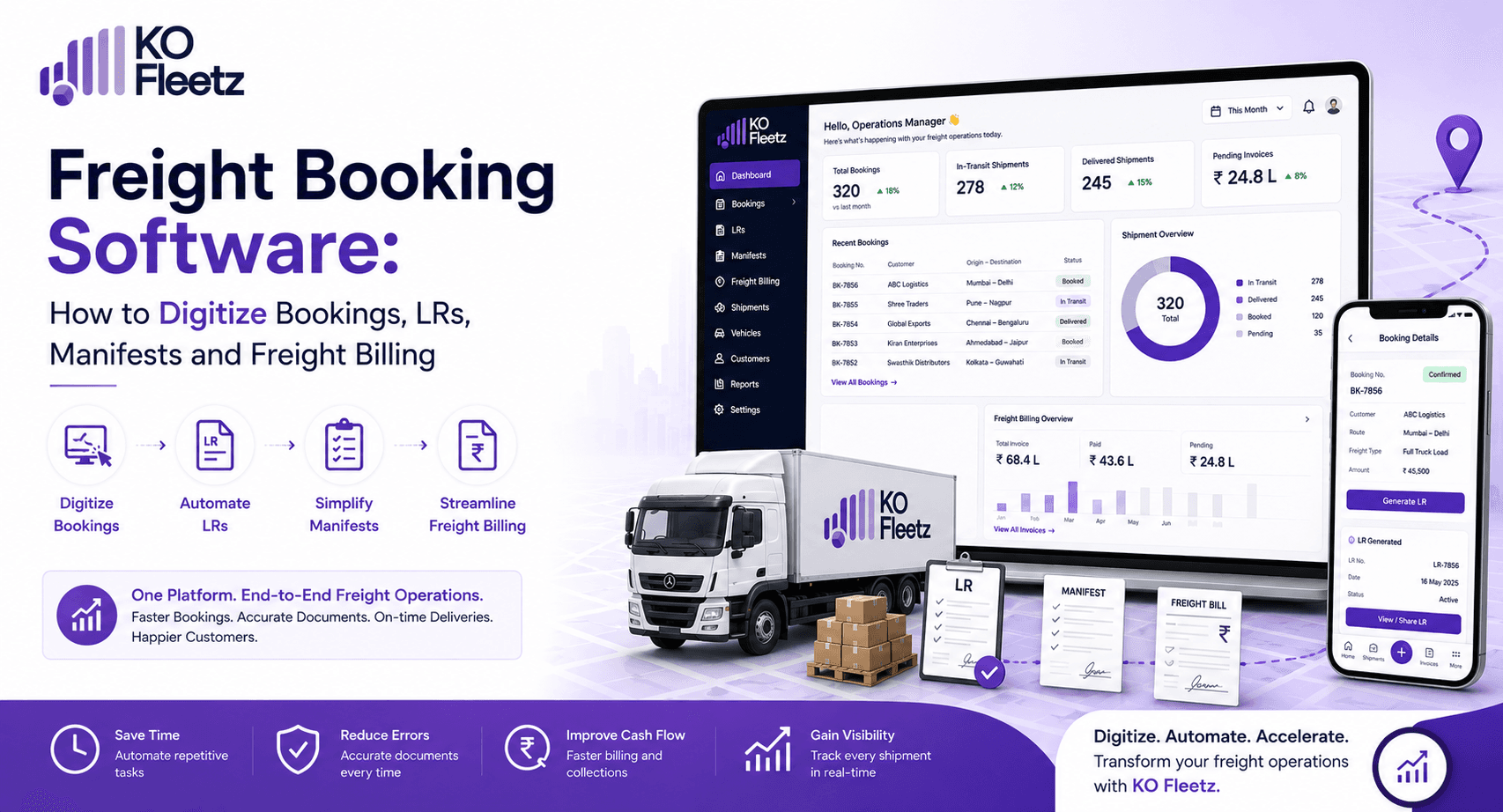
Freight Booking Software: How to Digitize Bookings, LRs, Manifests and Freight Billing

Discover how freight booking software digitizes consignments, lorry receipts, manifests, freight billing, part-load and full-load operations for modern logistics businesses.

KO Fleetz Admin18 August 202621 min read
Freight Booking Software: How to Digitize Bookings, LRs, Manifests and Freight Billing
On this page

Introduction

Freight operations often begin with a simple customer request.

A customer wants to move cargo from one location to another. A rate is agreed. The shipment is booked. An LR is generated. The cargo is assigned to a vehicle. A manifest is prepared. The shipment moves. Delivery is confirmed. Finally, the freight needs to be billed.

On paper, this sounds straightforward.

In practice, these activities can become disconnected across booking registers, spreadsheets, paper LR books, driver documents, manifests, emails, WhatsApp messages, and accounting systems.

That creates a critical problem:

The business knows the shipment moved, but the commercial record of that shipment is scattered across multiple places.

This can make it difficult to answer basic questions:

  • What exactly did the customer book?
  • What freight rate was agreed?
  • Which LR belongs to the booking?
  • Which consignments are on a particular vehicle?
  • Was the shipment full-load or part-load?
  • Has the consignment been delivered?
  • Can the freight be billed?
  • What documents support the bill?
  • Was the agreed rate changed?
  • Which consignments are still in transit?

This is where freight booking software becomes valuable.

A modern freight booking system creates a digital record of the consignment from the moment it is booked and connects that record with the LR, manifest, delivery status, and freight billing process.

For logistics and transportation businesses, this can replace disconnected paperwork with a more structured digital workflow.

KO Fleetz takes this approach by treating the booking and the vehicle trip as separate but connected records. The booking represents what the customer requested and agreed to pay, while trip management handles the vehicle, driver, stops, and actual movement.


What Is Freight Booking Software?

Freight booking software is a digital system used to capture, manage, and track freight bookings and the associated consignment information throughout the transportation process.

Instead of maintaining a booking in one system and creating the LR, manifest, and freight bill separately, the booking becomes a central operational record.

Depending on the system, freight booking software can manage:

  • Customer information
  • Consignment details
  • Cargo information
  • Load type
  • Freight rates
  • Vehicle requirements
  • Container details
  • Lorry receipts
  • Manifests
  • Delivery status
  • Freight billing
  • Documentation

The objective is to create a continuous information flow from:

Booking → Consignment → LR → Manifest → Delivery → Freight Bill

This reduces the need to repeatedly enter the same information at different stages.


Why Traditional Freight Booking Processes Create Problems

Many freight businesses still depend on a combination of:

  • Physical booking registers
  • Paper LR books
  • Excel spreadsheets
  • WhatsApp messages
  • Email
  • Manually prepared manifests
  • Separate accounting systems
  • Driver paperwork

Each individual tool may appear manageable.

The problem is what happens between them.

Imagine a customer books five consignments.

The booking team records them in a register.

Later, the operations team creates LRs.

The loading team prepares a manifest.

The driver carries physical documents.

The delivery team updates the shipment status.

The billing team then searches through documents to determine what should be invoiced.

If these records aren't connected, the business creates multiple versions of the same shipment.

This can lead to:

  • Duplicate data entry
  • Missing documents
  • Billing delays
  • Rate disputes
  • Incorrect freight bills
  • Difficult shipment reconciliation
  • Limited visibility
  • Manual follow-up

Freight booking software addresses this problem by creating a connected digital workflow.


Freight Booking Is Not the Same as Trip Management

One of the most important concepts in modern freight software is separating the commercial shipment from the vehicle movement.

A booking represents what the customer requested.

A trip represents the physical movement of a vehicle.

These aren't always one-to-one.

For example:

Scenario 1: Part Load

One truck carries:

  • Customer A's consignment
  • Customer B's consignment
  • Customer C's consignment

There are three commercial bookings but one vehicle trip.

Scenario 2: Large Shipment

One large customer booking may require:

  • Vehicle 1
  • Vehicle 2
  • Vehicle 3

There is one commercial booking but multiple trips.

If booking and vehicle movement are treated as the same record, these scenarios become difficult to manage.

KO Fleetz specifically separates the booking from trip management while allowing the records to reference each other.

This distinction is particularly valuable for transporters handling both full-load and part-load freight.


How Freight Booking Software Works

A modern freight booking workflow can be structured into several stages.

Step 1: Create the Freight Booking

The process begins when a customer requests transportation.

The booking can capture:

  • Customer
  • Consignor
  • Consignee
  • Cargo
  • Load type
  • Origin
  • Destination
  • Equipment requirements
  • Agreed freight rate
  • Other commercial information

Importantly, the booking can exist before a vehicle has been selected.

This allows the commercial side of the shipment to be captured first.

KO Fleetz follows this model, creating the booking as a record before the vehicle is assigned.


Step 2: Confirm the Consignment

Once the commercial information is confirmed, the booking moves forward in its lifecycle.

This gives operations teams visibility into which bookings are:

  • Draft
  • Confirmed
  • In progress
  • Completed

The exact statuses can vary by system, but the principle is important:

Every booking should have a clear state.

This prevents teams from relying on spreadsheets or memory to determine which shipments are active.


Step 3: Generate the Lorry Receipt

Once the consignment is associated with a vehicle movement, the lorry receipt (LR) becomes the operational document associated with that consignment.

An LR can capture information related to:

  • Consignor
  • Consignee
  • Cargo
  • Vehicle
  • Shipment
  • Freight
  • Delivery
  • Consignment details

KO Fleetz gives each LR its own lifecycle rather than automatically forcing every LR under a booking to share the same status.

This becomes particularly useful for part-load operations.


Step 4: Create the Manifest

A manifest answers a different question:

What is physically loaded on this vehicle for this run?

A manifest can bring together the LRs travelling on the same vehicle.

For a part-load transporter, this is especially important.

For example:

Vehicle TN XX XXXX

  • LR 1001 → Customer A
  • LR 1002 → Customer B
  • LR 1003 → Customer C
  • LR 1004 → Customer D

Instead of preparing the manifest separately from the booking and LR records, freight management software can assemble the vehicle's manifest from the consignments already recorded.

KO Fleetz's freight booking workflow specifically connects LRs to a vehicle-level manifest.


Step 5: Track Consignment Status

Once the shipment starts moving, each consignment should have its own operational state.

For example:

Confirmed → Assigned → In Transit → Delivered

This is important because not every consignment within a booking necessarily moves or gets delivered at the same time.

For part-load operations, one customer may receive their cargo today while another consignment on the same vehicle is delivered tomorrow.

Managing status at the LR or consignment level provides greater accuracy.


Step 6: Confirm Delivery

Once the shipment reaches its destination, the delivery state can be updated.

This creates a clear record of whether the consignment is:

  • Still pending
  • In transit
  • Delivered

The delivery state then becomes important for downstream processes such as billing.


Step 7: Generate the Freight Bill

One of the biggest advantages of a connected freight booking process is the relationship between the booking, LR, delivery status, and freight bill.

Instead of asking the billing team to reconstruct what happened, the bill can be generated from the relevant consignment information.

KO Fleetz positions freight billing around the LR's delivery state and the agreed booking price, creating a documented link between what was booked and what can be billed.

This can help reduce:

  • Billing delays
  • Missing freight bills
  • Rate disputes
  • Manual re-entry
  • Document searching

10 Benefits of Freight Booking Software

1. Centralizes Freight Bookings

All booking information can be maintained in one digital system.

Instead of searching across registers, spreadsheets, emails, and messages, teams can access the booking record directly.


2. Reduces Duplicate Data Entry

When booking information flows into the LR and manifest, teams don't need to repeatedly recreate the same shipment information.

This can reduce manual work and data-entry errors.


3. Improves LR Management

Digital LR management provides better visibility into individual consignments.

Teams can quickly identify:

  • LR number
  • Customer
  • Consignment
  • Vehicle
  • Status
  • Delivery state

This is particularly useful for businesses managing large volumes of consignments.


4. Simplifies Manifest Management

Instead of preparing a separate manifest from scratch, the system can connect the manifest with the LRs travelling on the vehicle.

This creates a more reliable record of what was actually loaded.


5. Supports Part-Load Operations

Part-load transportation creates complexity because one vehicle can carry shipments belonging to multiple customers.

A freight booking system should allow each consignment to maintain its own:

  • Customer
  • Rate
  • LR
  • Delivery status

while still connecting those consignments to the vehicle manifest.

This is a major advantage for LTL and part-load operators.


6. Supports Full-Load Operations

Full-load freight has a simpler structure.

One customer booking may correspond to one consignment and one vehicle movement.

A freight booking system can still maintain the same structured workflow while supporting the different characteristics of FTL operations.


7. Improves Freight Billing

When the agreed rate is captured during booking and connected to the consignment, the billing team has a clearer record of what should be charged.

This reduces dependence on memory and physical documents.


8. Improves Document Traceability

A digital system creates a relationship between:

Booking → LR → Manifest → Delivery → Bill

This makes it easier to investigate customer queries or billing disputes.


9. Improves Operational Visibility

Managers can see which bookings are:

  • Draft
  • Confirmed
  • Assigned
  • In transit
  • Delivered
  • Ready for billing

This provides a more accurate view of the freight pipeline.


10. Creates a Foundation for Freight Analytics

Once bookings and consignments are digitally recorded, businesses can analyze:

  • Booking volume
  • Customer freight
  • Part-load vs full-load
  • Freight revenue
  • Delivery performance
  • Vehicle utilization
  • Route profitability
  • Billing cycle time

This turns freight records into operational data.


Freight Booking Software for Logistics Companies

For logistics companies, freight booking is often the starting point of the entire shipment lifecycle.

A freight booking software for logistics companies should therefore do more than create a booking number.

It should connect commercial and operational information.

The ideal workflow is:

Customer Request

Freight Booking

Consignment

LR

Vehicle / Trip

Manifest

Delivery

Freight Billing

This connected approach reduces information gaps between sales, booking, operations, dispatch, delivery, and finance.


Freight Booking Software for Transport Companies

Transport companies have different operating models.

Some manage:

  • Full-load trucking
  • Part-load transportation
  • General cargo
  • Container movement
  • Import cargo
  • Distribution
  • Regional transportation

A flexible freight booking system should support these different shipment types without forcing every consignment into the same operational structure.

For example, KO Fleetz distinguishes full-load and part-load bookings because their billing and consignment relationships are different.


Freight Booking Software for Part Load Shipments

Part-load operations are one of the strongest use cases for structured freight booking software.

Imagine one truck carrying freight for five customers.

Each customer may have:

  • Different freight rates
  • Different destinations
  • Different LRs
  • Different delivery dates
  • Different billing requirements

The vehicle has one physical journey, but there are multiple commercial shipments.

A proper freight management system keeps these records separate while connecting them to the same manifest.

This prevents one customer's delivery from incorrectly changing the status of another customer's consignment.


Freight Booking Software for Full Load Shipments

Full-load shipments are generally easier to manage because one booking may correspond to one major consignment.

However, businesses still need accurate control over:

  • Customer
  • Cargo
  • Vehicle
  • Freight rate
  • LR
  • Delivery
  • Billing

Digitizing this workflow can improve consistency and provide a reliable record from booking to delivery.


Freight Booking and Billing Software

One of the most important connections in freight management is:

Booking → Billing

The agreed freight rate should be captured when the booking is made.

If the billing team has to reconstruct the agreed rate later from emails, calls, WhatsApp messages, or paper documents, disputes become more likely.

A connected freight booking and billing system keeps commercial information attached to the shipment.

If a rate changes, the system should also maintain an appropriate record of the change.

KO Fleetz allows pricing associated with a booking to be amended while retaining a recorded change rather than simply overwriting the original information.


Lorry Receipt Management Software

The LR is a critical document in freight transportation.

Traditional paper-based LR management can create challenges around:

  • Numbering
  • Missing documents
  • Duplicate numbers
  • Status tracking
  • Billing
  • Delivery confirmation

Lorry receipt software digitizes the LR lifecycle and connects it with the underlying consignment.

For organizations still transitioning from paper LR books, maintaining existing LR number series can also be important.

KO Fleetz supports existing LR number series and prevents duplicate numbering within the digital workflow.


Manifest Management Software

A manifest represents the cargo physically loaded onto a vehicle for a particular run.

A digital manifest can provide visibility into:

  • Vehicle
  • Driver
  • LRs
  • Consignments
  • Cargo
  • Load composition

This is especially useful for part-load transportation.

Instead of manually typing each shipment into a separate document, the manifest can be built from the consignments already recorded in the system.


Container Management and Freight Booking

Containerized freight introduces another level of complexity.

A shipment may need information such as:

  • Container number
  • Container type
  • Equipment
  • Cargo
  • Consignment
  • Movement details

Freight booking software with container management can connect container information to the underlying consignment.

KO Fleetz supports 20-foot and 40-foot equipment details against the consignment, creating container-level history.

This can be particularly relevant for:

  • Ports
  • Container logistics
  • Import movements
  • Freight forwarders
  • Transportation companies

Freight Booking Software vs Traditional Booking Registers

Traditional Booking ProcessFreight Booking Software
Paper registerDigital booking record
Manual LR creationConnected LR workflow
Separate manifestManifest linked to LRs
Manual status updatesDigital consignment status
Rate remembered or stored separatelyRate captured with booking
Paper-based billing processBilling connected to consignment
Difficult document retrievalCentralized records
Limited analyticsStructured freight data
High manual effortAutomated workflow

The biggest difference is not simply digital versus paper.

It is connected information versus disconnected information.


How Freight Booking Software Fits Into Fleet Management

Freight booking software does not have to replace fleet management software.

The two systems can complement each other.

Freight Booking

Manages:

  • Customer booking
  • Consignment
  • Freight rate
  • LR
  • Manifest
  • Delivery state
  • Freight billing

Fleet / Trip Management

Manages:

  • Vehicle
  • Driver
  • Stops
  • Trip
  • Actual movement
  • Vehicle activity

The two workflows can reference each other.

This means the commercial side knows which vehicle movement fulfilled the booking, while the operational side knows which consignments are being carried.

KO Fleetz deliberately separates these responsibilities while connecting the relevant records.


Freight Booking Software and GPS Tracking

It is important to distinguish consignment status from actual vehicle location.

A booking system may tell you that an LR is:

In Transit

But that does not automatically mean the system knows the truck's precise geographical position.

Actual vehicle location requires a tracking system.

This is why freight booking software can work alongside GPS fleet tracking software.

The booking system answers:

What shipment is moving?

The tracking system answers:

Where is the vehicle?

Together, they provide a more complete operational picture.

KO Fleetz explicitly distinguishes LR status from actual vehicle location, with physical location coming from the tracking module when tracking is available.


Freight Booking Software and E-Way Bill Compliance

Freight operations in India often involve regulatory documentation and e-way bill requirements.

Connecting freight booking information with compliance workflows can reduce duplicate data entry.

Instead of manually entering consignment information again, downstream compliance processes can use the existing shipment record.

KO Fleetz positions its e-way bill module alongside the freight booking workflow, allowing consignment information to flow into the compliance process.


Freight Booking Software for Indian Logistics Businesses

Indian logistics operations often involve a combination of digital and manual processes.

Customers may send bookings through:

  • Email
  • Phone
  • WhatsApp
  • Customer portals
  • Shipper systems

The challenge is not always the absence of technology.

It is the lack of a consistent system for turning those requests into structured freight records.

A practical freight booking system should accommodate real-world booking processes while creating a structured digital record once the booking enters the organization.

This is particularly important for transporters transitioning from paper-based LR books and manual registers.


Key Features to Look for in Freight Booking Software

Before selecting a freight management system, evaluate whether it supports the complete booking lifecycle.

Booking Management

Can you create and manage bookings before vehicle assignment?

Consignment Management

Can each consignment maintain its own status and information?

LR Management

Can the system generate and track lorry receipts?

Manifest Management

Can multiple LRs be grouped into a vehicle manifest?

Full Load and Part Load

Can the system handle both operating models?

Freight Rate Management

Can agreed rates be captured and maintained?

Freight Billing

Can billing be connected to the actual consignment?

Container Management

Can container and equipment details be associated with shipments?

Delivery Status

Can each LR have its own delivery state?

Integration

Can the freight system connect with accounting, compliance, tracking, or other systems?

Analytics

Can management analyze freight activity and profitability?

These capabilities determine whether a system is simply a booking tool or a broader freight operations platform.


How to Choose the Right Freight Booking Software

When evaluating freight booking software for logistics companies, don't start by asking:

"How many features does it have?"

Start with:

"Does it match how our freight operation actually works?"

Evaluate the software against your workflows.

Ask these questions:

  1. Can we create bookings before vehicle assignment?
  2. Can one vehicle carry multiple customer consignments?
  3. Can one booking be fulfilled through multiple trips?
  4. Can every LR have its own status?
  5. Can we create manifests from LRs?
  6. Can we handle both full-load and part-load?
  7. Can we preserve existing LR numbering?
  8. Can agreed freight rates be recorded?
  9. Can rate changes be tracked?
  10. Can freight bills be generated from delivery information?
  11. Can container information be maintained?
  12. Can the system connect with trip management?
  13. Can it integrate with compliance systems?
  14. Can management analyze freight performance?

The best system is one that fits the actual operational model rather than forcing the business to redesign its workflow around the software.


Why KO Fleetz for Freight Booking?

KO Fleetz approaches freight booking around a simple principle:

The booking is the commercial promise, while the trip is the vehicle fulfilling that promise.

The platform keeps the booking, LR, manifest, delivery state, and freight billing connected while maintaining a deliberate separation between freight records and vehicle trip execution.

With KO Fleetz, freight businesses can manage:

  • Freight bookings
  • Consignments
  • Lorry receipts
  • Vehicle manifests
  • Full-load shipments
  • Part-load shipments
  • Freight rates
  • Container information
  • Freight bills
  • Import and general cargo streams

The platform also connects the freight booking workflow with capabilities such as trip management, e-way bill compliance, fleet finance, GPS tracking, and broader fleet operations.

This creates a broader operational ecosystem rather than treating freight booking as an isolated activity.


Example: From Customer Booking to Freight Billing

Consider a transporter receiving a request from a customer.

Stage 1: Booking

The customer requests transportation for three consignments.

The operator records:

  • Customer
  • Cargo
  • Destination
  • Load type
  • Freight rate

Stage 2: LR

Once vehicles are assigned, LRs are created for the relevant consignments.

Stage 3: Manifest

The LRs travelling on each vehicle are grouped into a manifest.

Stage 4: Movement

The vehicle trip is managed separately through the trip management workflow.

Stage 5: Delivery

Each LR receives its own delivery status.

Stage 6: Billing

The freight bill is generated using the booking's commercial information and the delivery state.

The entire process becomes:

Customer Request

Booking

LR

Manifest

Trip

Delivery

Freight Bill

This creates a traceable digital record from the original customer request through the final billing stage.


Freight Booking KPIs to Monitor

Once freight booking is digitized, businesses can measure more than booking volume.

Useful KPIs include:

Booking Volume

Number of bookings received during a period.

Booking Conversion

Percentage of enquiries converted into confirmed bookings.

Part-Load vs Full-Load Ratio

Helps understand shipment mix.

Average Freight Value

Measures average commercial value per booking.

Billing Cycle Time

Measures the time between delivery and freight billing.

Pending Billing

Identifies delivered consignments that have not yet been billed.

Delivery Completion Rate

Measures completed versus pending consignments.

Rate Variance

Tracks changes between originally agreed and final freight rates.

Booking-to-Delivery Time

Measures the overall shipment lifecycle.

Freight Profitability

Connects freight revenue with trip and operating costs.

These metrics can help management understand both commercial and operational performance.


The Future of Freight Booking

Freight operations are moving toward connected digital workflows.

The future isn't simply about replacing a paper LR with a digital LR.

It is about connecting the entire lifecycle:

Customer

Booking

Consignment

LR

Manifest

Vehicle Trip

Tracking

Proof of Delivery

Freight Billing

Finance & Analytics

When these stages are connected, businesses can reduce manual reconciliation and gain a more complete view of freight operations.

AI can further extend this by helping teams identify unusual freight patterns, delayed billing, customer trends, route profitability, underutilized capacity, and other operational opportunities.


Frequently Asked Questions

What is freight booking software?

Freight booking software is a digital system used to create, manage, and track freight bookings and consignments through processes such as LR generation, manifest creation, delivery tracking, and freight billing.

Who needs freight booking software?

Logistics companies, transporters, trucking companies, freight operators, distribution businesses, and other organizations managing regular freight bookings can benefit from a digital freight booking system.

What is the difference between freight booking software and TMS?

A TMS can cover broader transportation planning and execution functions. Freight booking software focuses specifically on the commercial consignment lifecycle, including bookings, LRs, manifests, delivery status, and freight billing.

Can freight booking software handle part-load shipments?

Yes. A suitable system should allow multiple customer consignments to exist independently while associating them with the same vehicle manifest.

Can freight booking software handle full-load shipments?

Yes. Full-load shipments can be managed as individual bookings with their associated LR, vehicle movement, delivery, and billing information.

What is LR management?

LR management refers to digitally creating, numbering, tracking, and managing lorry receipts associated with freight consignments.

Does freight booking software track vehicle location?

Not necessarily. Freight booking software can track consignment status, but real-time vehicle location generally requires GPS fleet tracking or a connected telematics system.

Can freight booking software improve billing?

Yes. Connecting agreed freight rates and delivery status with the consignment can reduce manual reconciliation and make freight billing more traceable.

Can freight booking software manage containers?

Some platforms support container and equipment details. This is useful for port, import, and container logistics operations.

How does freight booking software help logistics companies?

It can centralize booking information, connect LRs and manifests, support full-load and part-load operations, improve billing traceability, reduce duplicate data entry, and create structured freight data for analysis.


Conclusion

Freight transportation doesn't begin when a truck starts moving.

It begins when a customer makes a booking.

That booking contains the commercial promise: what needs to move, where it needs to go, and at what agreed rate.

The vehicle trip is what fulfills that promise.

When those two concepts are mixed together, freight operations become harder to manage, particularly when one vehicle carries multiple consignments or one booking requires multiple trips.

Freight booking software creates a structured digital record that follows the consignment from booking through LR, manifest, delivery, and freight billing.

For logistics and transportation companies, this can create a more connected workflow across commercial, operations, dispatch, delivery, and finance teams.

With KO Fleetz, freight businesses can manage the booking as its own record while connecting it to lorry receipts, manifests, delivery states, freight billing, container details, and related fleet operations.

The result is a simple but powerful shift:

From disconnected booking registers to connected freight operations.

And when every booking has a clear digital trail, businesses can spend less time reconstructing what happened and more time managing what happens next.

Ready to digitize your freight booking workflow?

Explore KO Fleetz Freight Booking Software

Share
  • FMCG & Distribution

    Fleet Management Software for FMCG Distribution

    Fleet management software for FMCG helps distributors optimize delivery routes, reduce fuel costs, improve vehicle utilization, track deliveries, and streamline daily distribution operations.

    31 Aug 20262 min
  • Manufacturing

    Fleet Management Software for Manufacturing Companies

    Discover how fleet management software helps manufacturing companies reduce transportation costs, improve vehicle utilization, minimize downtime, optimize fleet operations, and gain better visibility across their transportation network.

    28 Aug 20266 min
  • Fleet Management Software

    Common Fleet Management Challenges and Solutions

    Fleet managers face challenges involving fuel costs, vehicle maintenance, driver performance, route efficiency, compliance, and operational visibility. Discover practical solutions for improving fleet operations.

    27 Aug 20265 min

See KO Fleetz running on your fleet

A 30-minute walkthrough using your vehicles, your routes and the problems you are actually trying to solve.